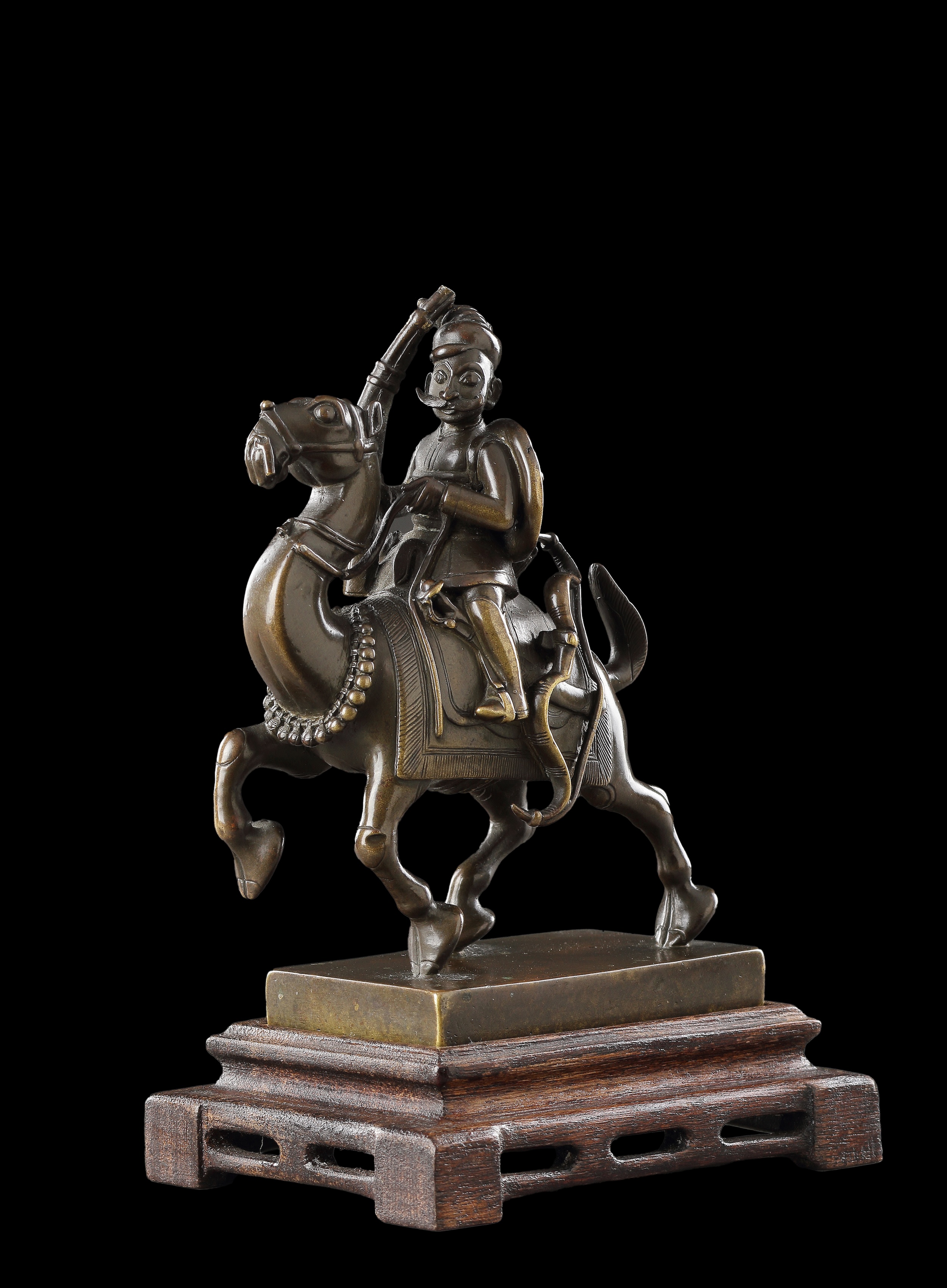
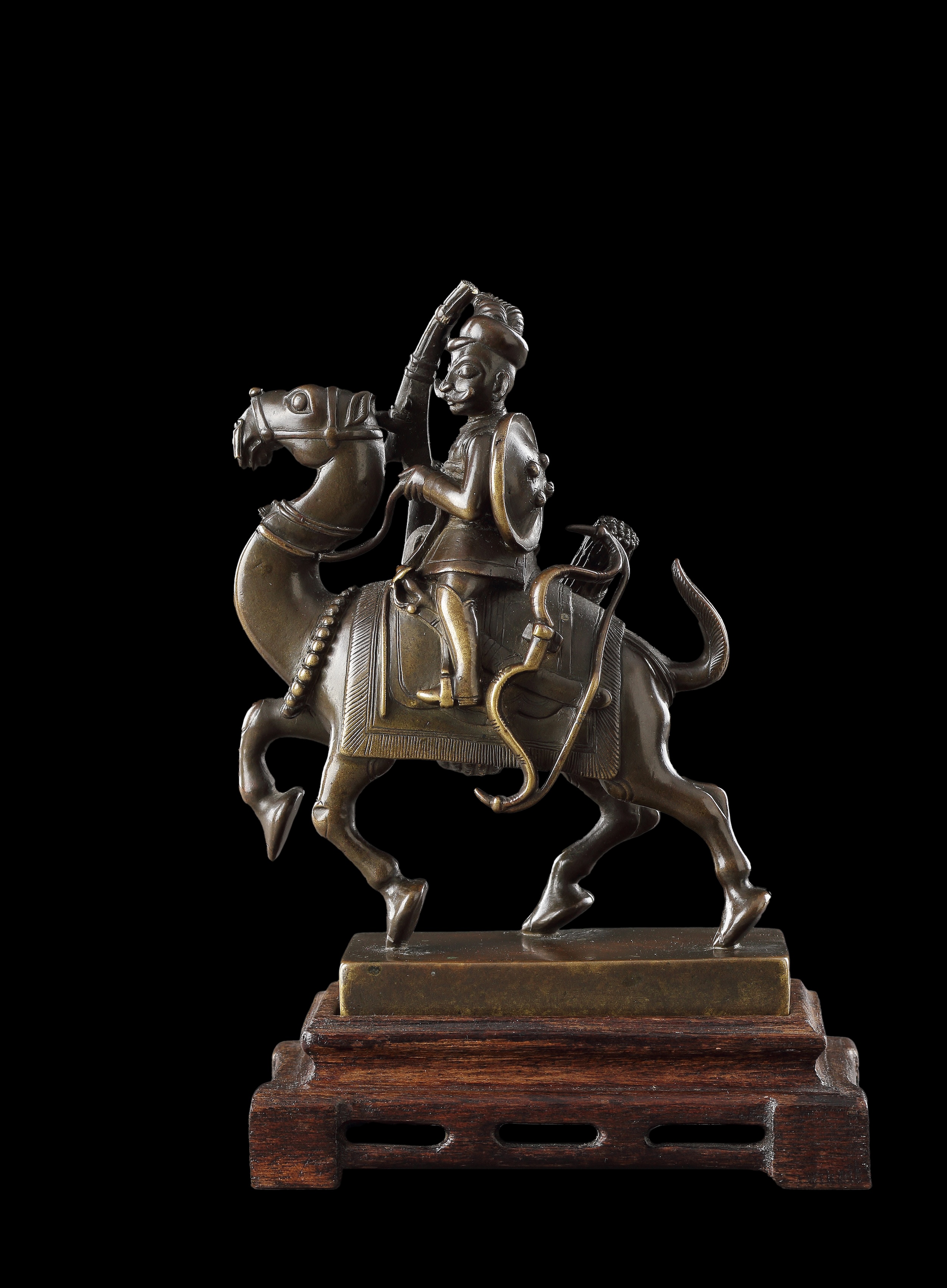
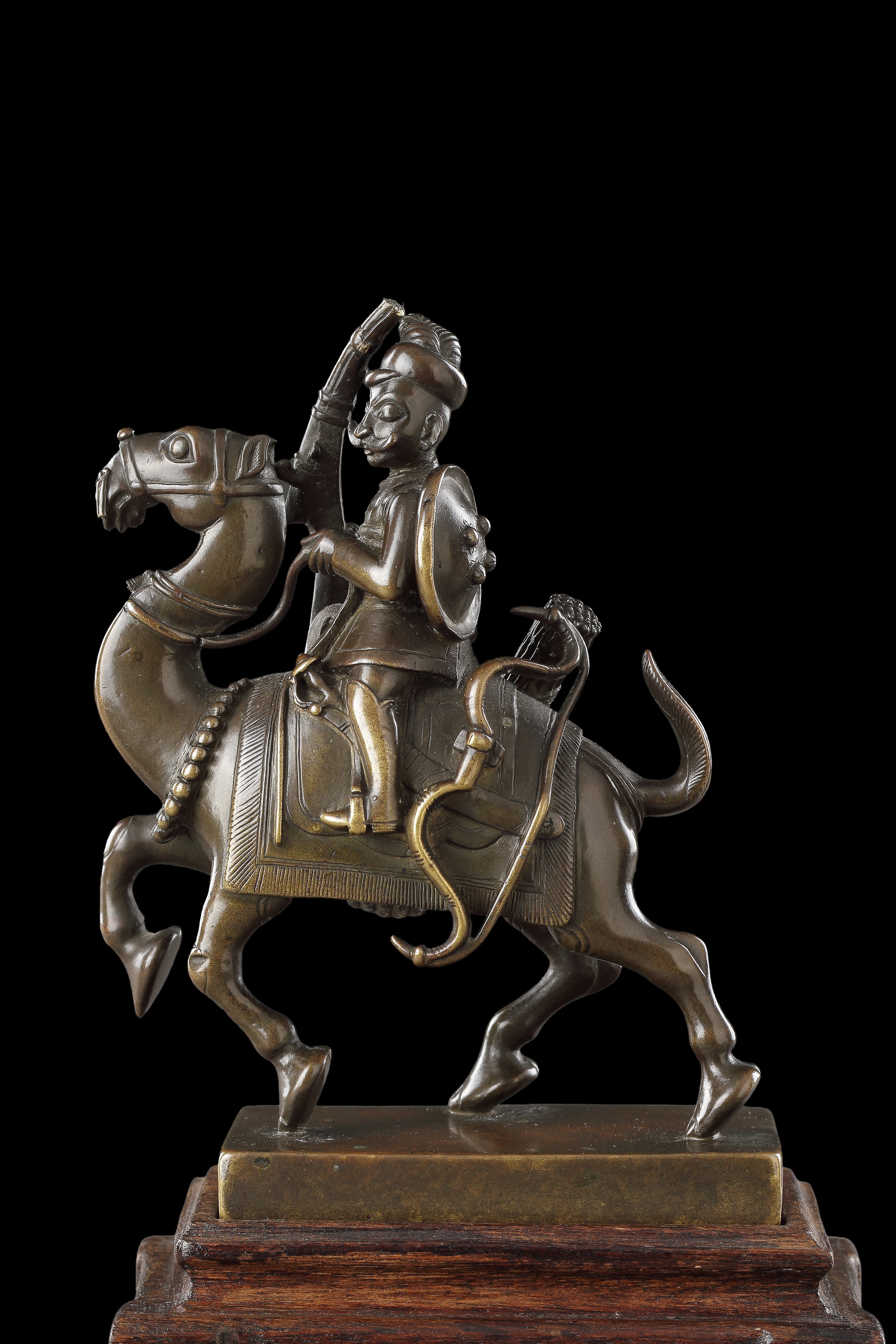
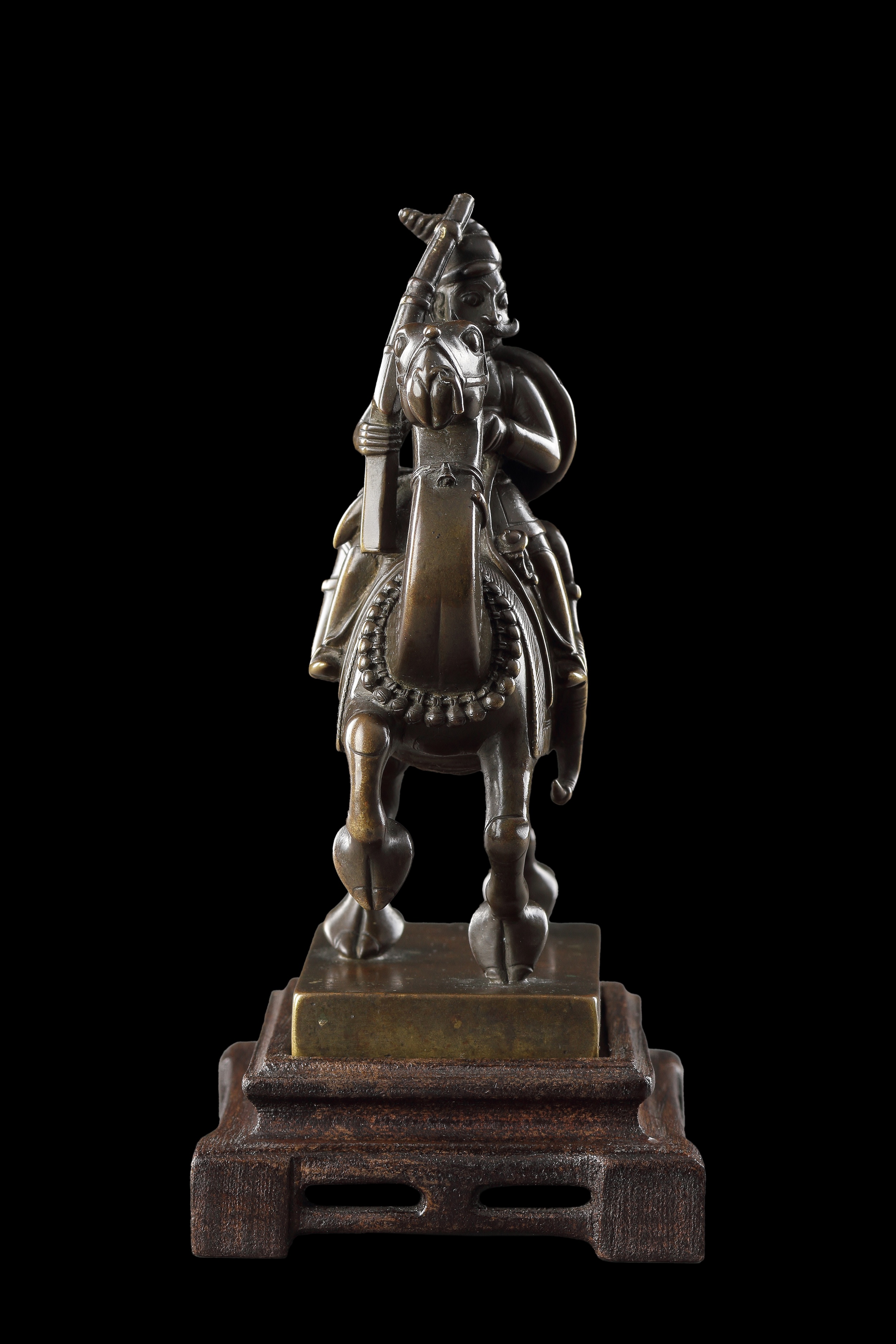
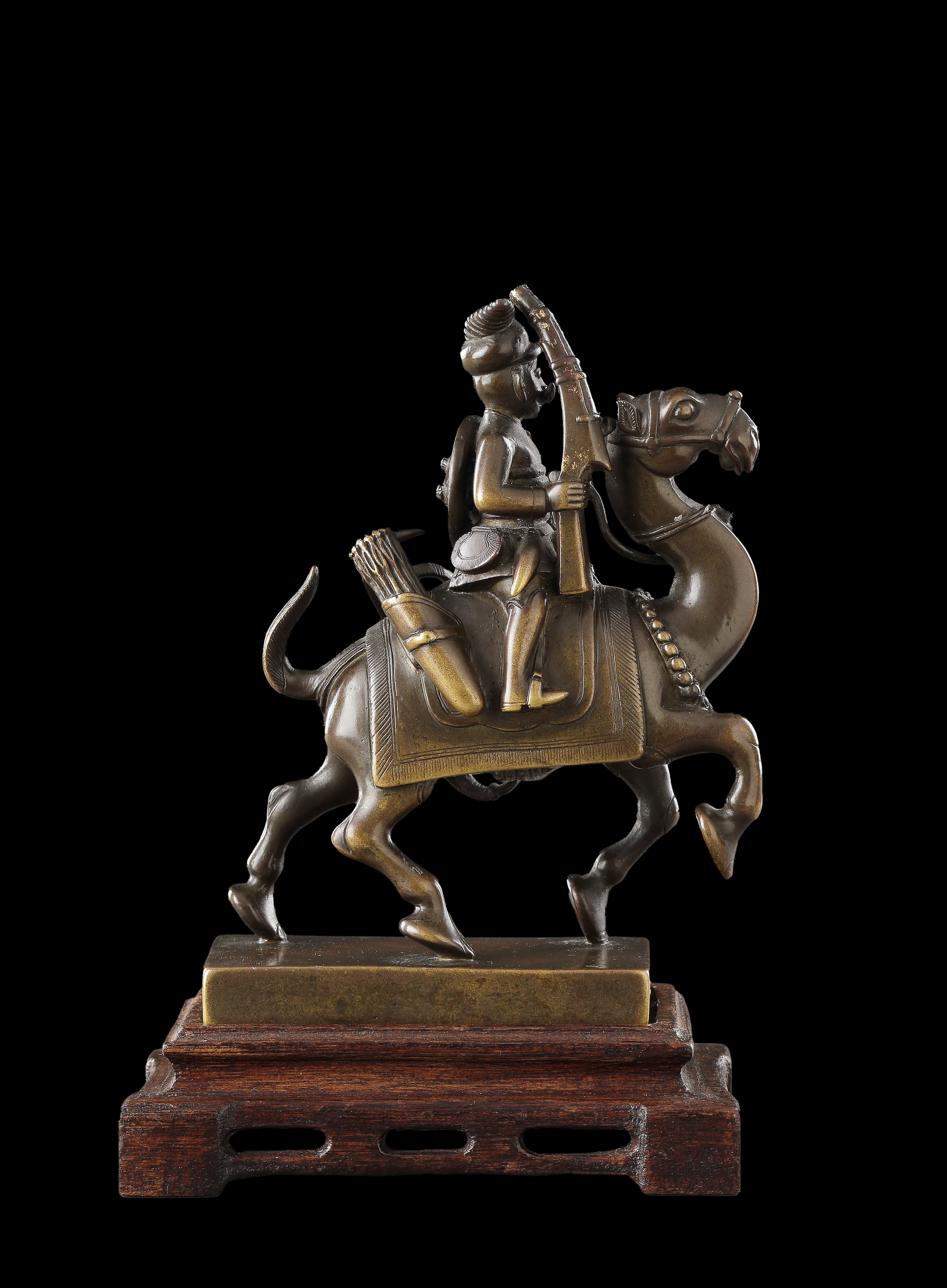
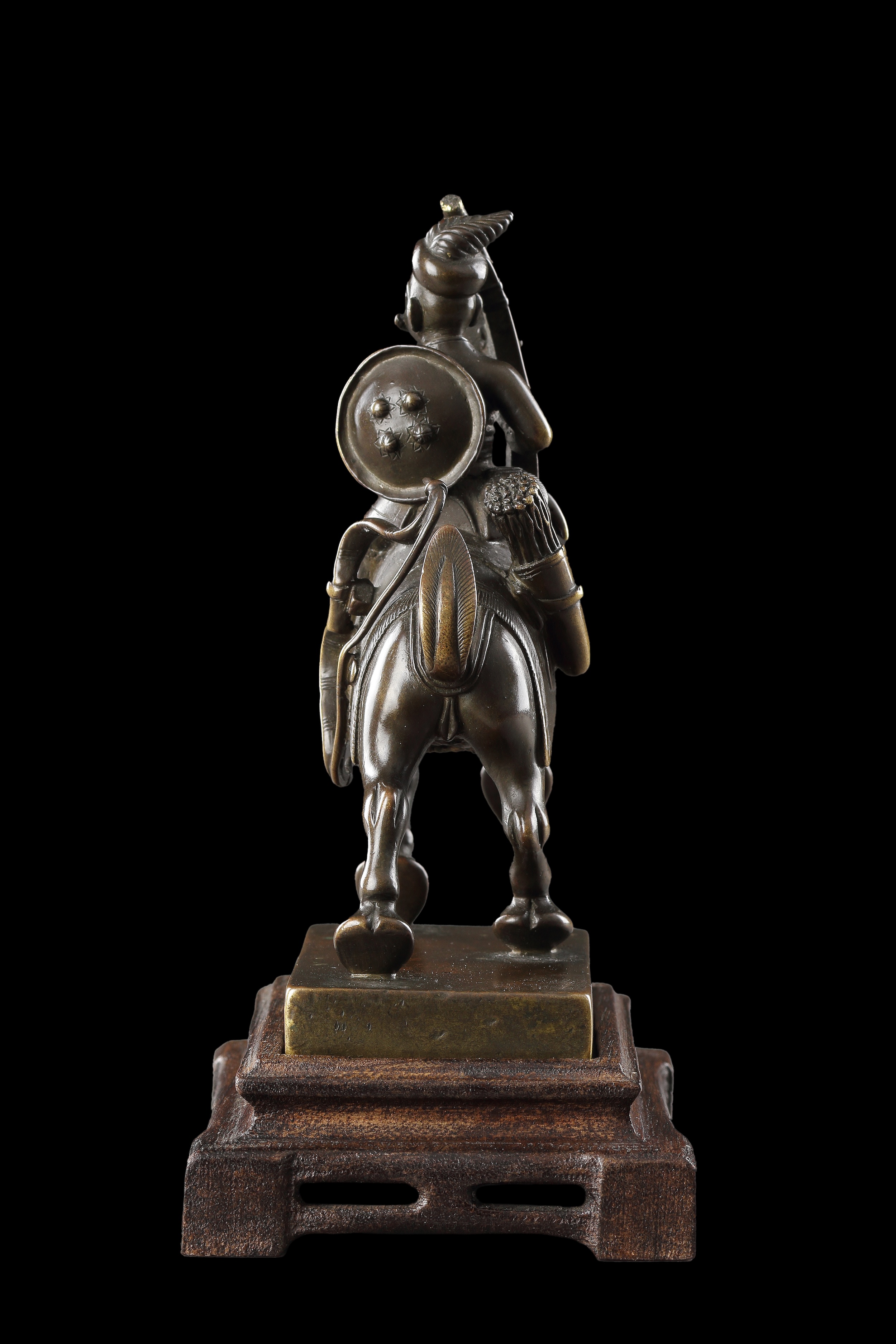
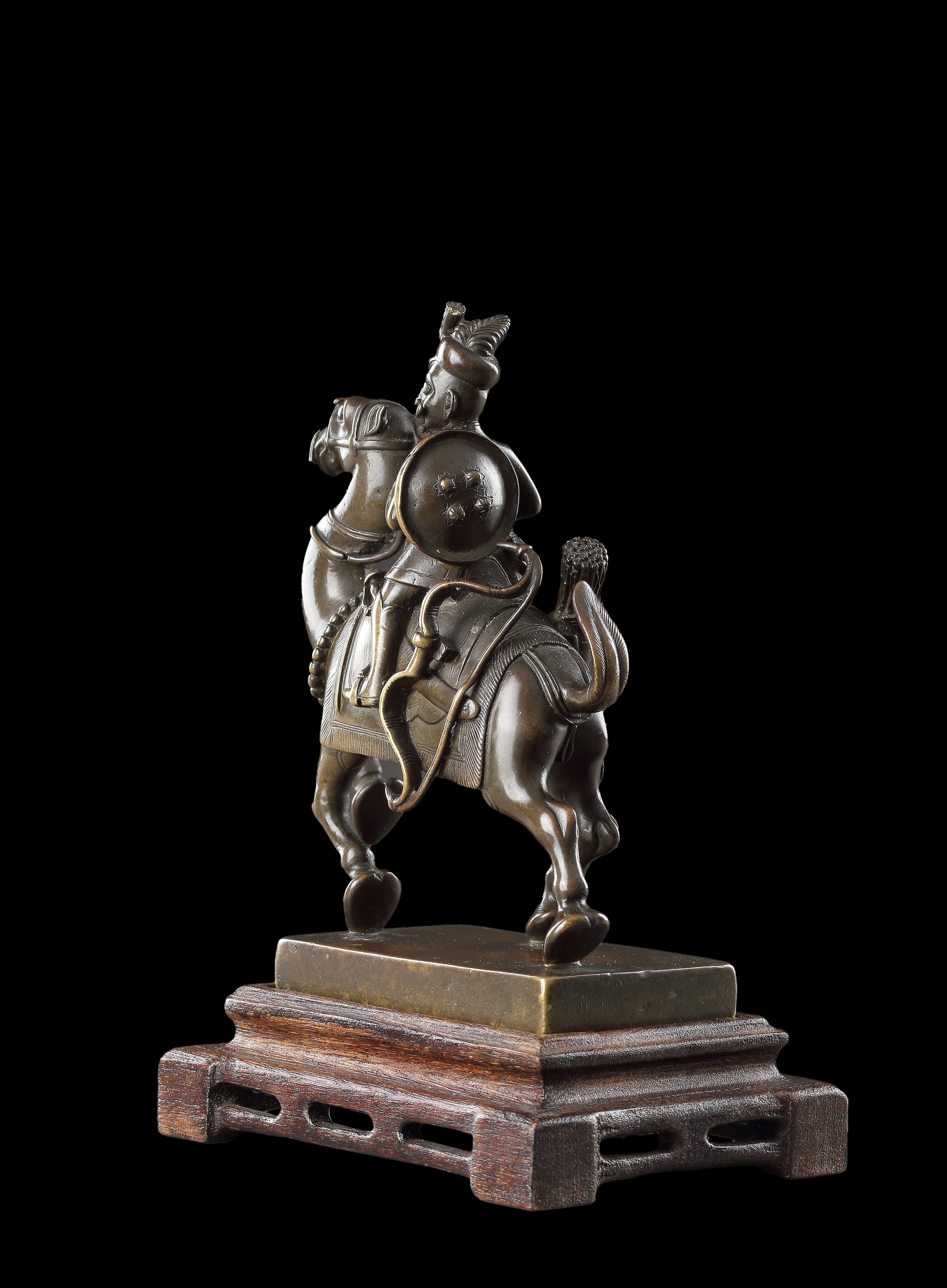
Toy of a moustachioed warrior riding a camel
Visaskhaptam (India)
circa 1795
Height: 120mm
Height with wooden base: 145mm
Brass, wood
A mounted, moustachioed warrior rides a prancing camel, holding an oversized matchlock carbine in his right hand (piece from the tip missing), and the reins in his left. He wears a turban adorned with a prominent plume, and across his body is slung a thick, rolled dhal (shield) over his left shoulder.
From the saddle carpet hangs a tulwar (curved sword) beneath the rider’s left leg, while a recurved bow and a quiver filled with arrows are secured at the rear. His belt is equipped with both a powder flask and an ammunition flask.
The camel, captured mid-stride with a gracefully arched neck decorated with bells, stands upon a rectangular hollow base and is mounted on an associated wooden stand.
Toy soldiers of Visakhapatnam (India), circa 1795
When such examples of eighteenth-century Indian brass military figures were displayed at the Paris International Exhibition in 1878, Sir George Birdwood, keeper of the Indian Museum at South Kensington (now part of the Victoria and Albert Museum) claimed that the craftsman appeared to have been inspired by Gustave Doré’s illustration of Don Quixote. He also went on to praise the modelling and felt that ‘they graphically illustrate the whole gamut of military swagger in man and beast’.2
These figures were originally part of a large set reportedly belonging to Timma Razu, Raja of Peddapuram (d.1796). They were said to have been commissioned on the advice of his astrologers to enable the Raja to review his troops daily without the need of bloodshed. Another version is that the figures were made on advice of his astrologers for presentation to Brahmins in order to avert his threatened death.
It is important to note that none of the known figures appear to be identical, closely related figures have slightly differing features. That is because, unlike Western toy soldiers, they are not manufactured by piece-moulding but are individually modelled and cast by the cire perdue process. It is not known who the talented artist responsible for their manufacture is,but they certainly had an eye for caricature.
Their dating and attribution is mainly based upon unique inscriptions on an elephant figure in the Ashmolean museum in Oxford, giving the date 1795 on it’s forehead and the name Vizagapatam in Roman capitals on its rump (acc.no. EA1969.44.a.). The Ashmolean have a further ten figures from the group. Others are in the Royal Collection Trust (UK), the Victoria and Albert Museum, the National Army Museum (London), and the David Collection.
See Royal Collection Trust for a similar figure (RCIN’s 10838-10848), published in ‘Splendours of the Subcontinent – A Princes Tour of India’, by Kajal Meghani, London, 2017.
1 Birdwood, Paris Universal Exhbition of 1878: Handbook to the British India Section, London,1878, p.62
2 Birdwood, Indian Arts, 1884, volume II, London, p194
See Royal Collection Trust for a similar figure (RCIN’s 10838-10848), published in ‘Splendours of the Subcontinent – A Princes Tour of India’, by Kajal Meghani, London, 2017.