The fine and tightly organised, raised lines that course across Suminder Virk’s canvases are magnetising. The tracks, like meticulously raked sand, corrugated metal or threads in a delicately woven fabric, have an accumulative effect. En masse and viewed at a distance, her textural surfaces play with light and colour seeming to undulate, hum and ripple with a slow intensity. In Scorching June 2 (2025, these lines appear derivative of contours on a map and evoke the shape of land. At the painting’s base, the repeated and dense lines build up a rugged stretch of brown, mountainous terrain above which a fiery yellow plane looks animated with forces rarely seen, such as undercurrents and air pressure.
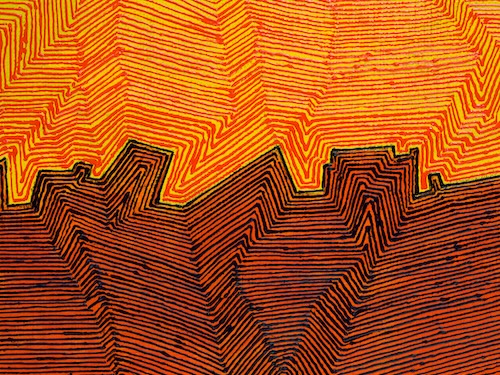
These paintings can be considered a poetic and charged mapping. Each abstracts the built fabric of India’s planned city, Chandigarh, where Virk grew up, and suffuses it with ancestral memories. Virk’s experiences of this place, including both physical and emotional recollections, are translated onto her canvases intuitively, using a distinctive painterly approach. She deploys a piping method that draws on mehndi hand decorating techniques. Instead of henna though, it is oil paint that is squeezed out from a conical bag on to her surface to create ridges of pure colour.
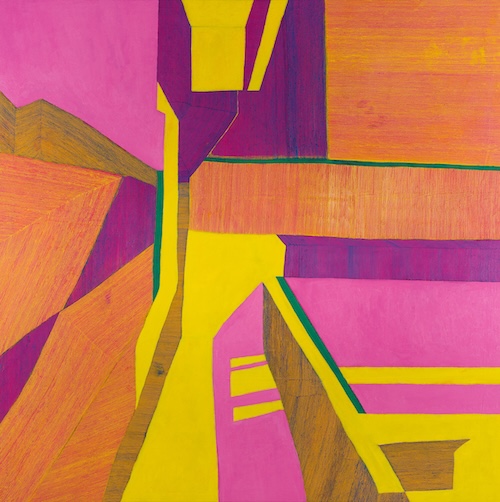
This idiosyncratic form of paint application taps into the gender politics underlying the foundations of most global cities. The urban environment is predominately planned, designed, engineered and built by men. Gender is, as geographer Kim England notes, “fossilized into the concrete appearance of space.”* Le Corbusier, whose proportional system Le Modulor was based on the dimensions of a 6ft tall man, developed the master plan for Chandigarh. His designs for the Capital Complex centred the vision of a European male body. Virk visualises these sites and surroundings differently. The way she interacts with this urban habitat, using the highly specialised, feminine mehndi process associated with ceremonial adornment, is a means of, she says, “subverting the power and authority of established systems and patriarchy.”
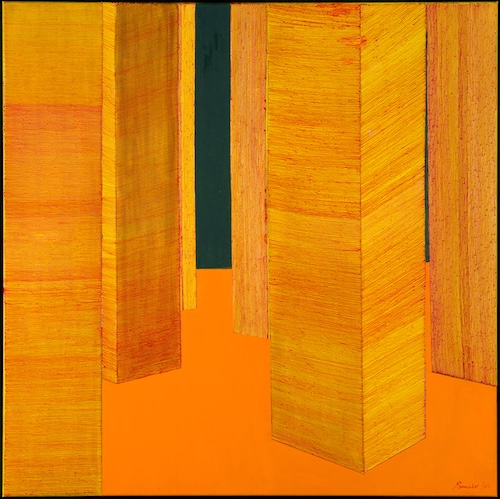
Her choice of depicting exterior facades, rather than interior and domestic settings, in a way, further accentuates the inhospitality of metropolitan, public space. Virk’s perspectives oscillate and place the viewer distanced, up close, dwarfed and, at times, seemingly caught between buildings. Balcony (2024) can feel like one is looking upwards through a narrow aperture to the sky. Columnar Rhythms (2025) similarly evokes a sense of claustrophobia with a cluster of columns almost closing in on the space left between them. Although unpeopled, Virk’s compositions allude to human presence and activity. She finds in the buildings she has observed “remnants of politics and history” and is drawn to “the process of cities growing and changing in a layered organic manner.” Her paintings conjure this sense of urban accumulation and evolution. They possess a vitality and can seem to buzz, even blur in a way that can be closely associated with the dynamics and sprawl of Indian cities.
Suminder Virk’s work will be exhibited by Runjeet Singh Gallery at Art Mumbai
Booth C82
Mahalaxmi Racecourse
Mumbai
13 – 16 November 2025
* Kim England, “Gender Relations and the Spatial Structure of the City,” Geoforum, 22,2 (1991): 136.