Exhibition review | Runjeet Singh Gallery, Royal Leamington Spa | 5 June-25 July 2026
Runjeet Singh Gallery in Royal Leamington Spa opened in 2026 with a clear interest in contemporary South Asian and diasporic art. Its second exhibition, Structures of Belonging, brings together British architect and artist Karl Singporewala and painter Suminder Virk. Singporewala makes precise sculptural objects from laser-cut paper, timber and printed plastic. Virk builds dense painted surfaces from brutalist & modernist facades, corridors and stairs. Yet both artists treat architecture as something carried within the body. A building, a household object or a geometric sign becomes a place where family memory can settle.
The pairing works because neither artist presents belonging as a finished identity. Singporewala considers how Zoroastrian values and Parsi ritual pass between generations; Virk returns to Chandigarh while looking closely at Birmingham, her present city.
In her curatorial note, curator Lottie Gregory frames architecture as more than physical structure. It becomes an emotional and psychological space through which faith, family, heritage and identity are preserved and reimagined. This gives the exhibition its centre: belonging is not a fixed location, but something built, handled and revised.
Zoroastrianism is one of the world’s smallest living religions, numbering perhaps 100,000 to 120,000 people worldwide, most of them Parsis concentrated around Mumbai, with smaller communities in Karachi and beyond. For anyone outside that circle, or without Parsi friends to open a door into it, their lifestyle tends to appear at a distance: through Bapsi Sidhwa’s comic, unsparing fiction, much of it set in Lahore, where a handful of old Parsi houses still stand in areas like Gulberg, many of them long empty; through Sooni Taraporevala’s photographs of Parsi homes and rituals; through the odd documentary trying to capture what remains before it thins further.
Sidhwa gives an account in words, Taraporevala one in two-dimensional photographs. Karl takes a further plunge, into three dimensions, into sculpture you can walk around and touch, blown up to monumental scale in one piece and shrunk to miniature in the next. Parsi by family and Zoroastrian by inheritance, his is a lineage that left India for East Africa across generations before it left East Africa again for England, a migration folded into one identity so that home was never a single fixed place to begin with, let alone one already receding. It is this compounded distance, rather than direct access, that his work seems to translate: ceremonial objects, funerary architecture and inherited memory, enlarged, coloured and rebuilt until they can be met with entirely new eyes.
Singporewala’s architectural training is visible in the exactness of his cuts and repeated forms, but the structures never feel like neutral models. Thoughts, Words and Deeds (all 2025) are two-metre laser-cut sheets of Indian handmade cotton rag. Circles, triangles and squares form vast tessellations, each gathering into a larger elemental shape. The geometry distils the Zoroastrian ethic of good thoughts, good words and good deeds. From a distance the sheets seem ordered and monumental; close up, the soft paper moves slightly. Hung as loose sheets rather than fixed panels, they occupy the room like banners or screens and make faith architectural. Moral instruction is given a pattern without becoming rigid.
Sense of Ses (Colour) and Sense of Ses (Chrome) (2025) begin with the SES, a metal ritual tray used at Parsi weddings, Navjote initiations and New Year. Its four forms are: Sopāro, a tall conical rock-sugar vessel linking sweetness and abundance to sacred Mount Hara; Pigāni, a bowl for vermilion and rice used in blessings; Dīvo, an oil lamp representing divine wisdom, truth and purity; and Gulābdān, a rosewater sprinkler for welcome, purification and blessing. Remade in chrome-plated or brightly coloured PLA, they become tactile objects Singporewala’s children can touch, rearrange and remember. Belonging is learned through the hands.
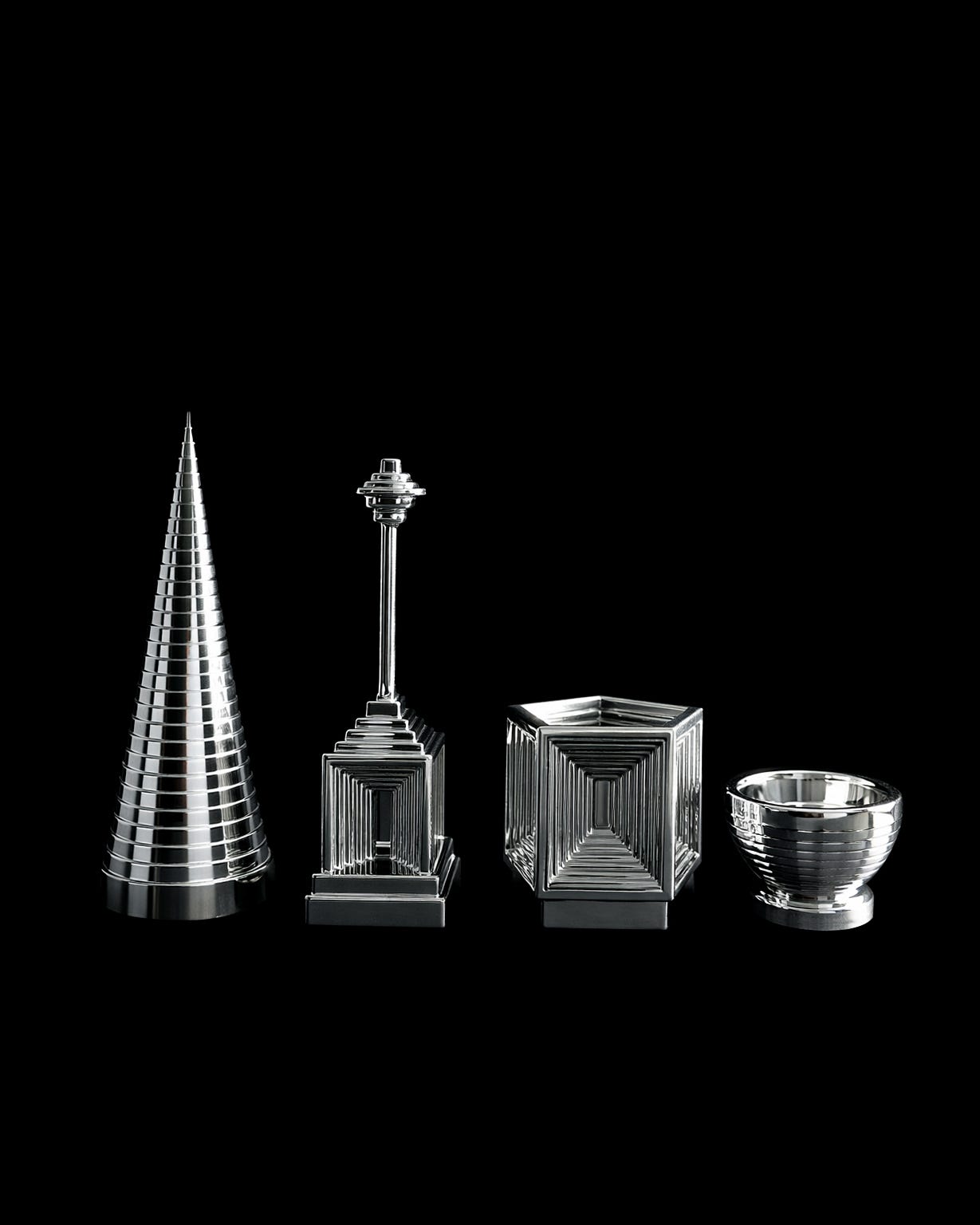
The two finishes carry different emotional weights. Chrome recalls the valued metal of a family tray and briefly reflects the room around it. The coloured version feels immediate and playful. Neither is treated as more authentic. Singporewala allows a precious ritual object and an inexpensive contemporary material to share the same shape. Karl has crafted overlife size versions of these scualptures too.
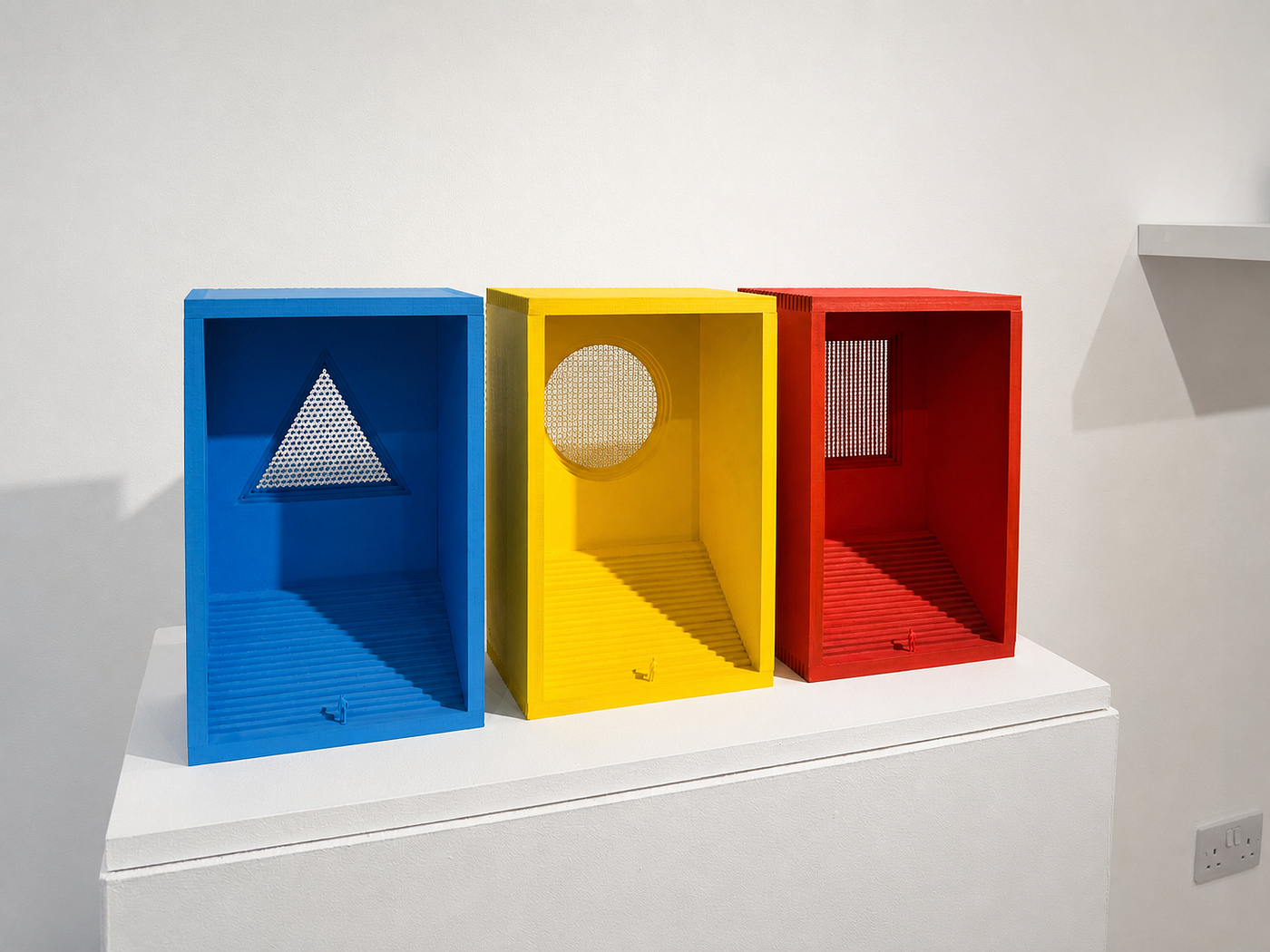
Sanctus No. I, II, III (2024) makes the shift from object to imagined space especially clear. Three laser-cut timber chambers are painted blue, yellow and red; each has a triangle, circle or rectangular opening. Tiny model figures alter their scale, so a box on a plinth begins to feel like a shrine, stage or entrance to a much larger building. The primary colours keep the chambers playful, even as their symmetry and deep openings suggest sacred authority. Ribbed floors pull the eye inward and light through the perforations throws patterned shadows across each chamber. The figures turn looking into an imagined act of entering.
Palmyra Unbuilt (2016) reconstructs the arch at Palmyra, destroyed by ISIS in 2015, from thousands of enamelled plastic architectural figures. In a conventional maquette, these figures provide scale and remain incidental; here they become the building. Packed together, they suggest the lives and histories that once passed beneath the monument, while the destroyed arch makes cultural inheritance vulnerable to violent erasure. Human presence is not added after the structure. It is what holds the structure up. The many figures reverse the usual hierarchy between a monument and the people around it. Cultural memory is carried by bodies, not by stone alone.

Under glass, the arch looks solid from a distance and fragile close up, where every figure remains visible. The work does not pretend to restore what was lost. It holds destruction, memory and reconstruction inside the same small structure.
Suminder Virk grew up in Chandigarh, the post-Partition city shaped from 1951 by Le Corbusier’s concrete buildings, ramps and deep sun screens. A year-long residency in her birth city after years of moving to Birmingham, supplied photographs she cuts apart, recolours and rebuilds. Virk fills traditional mehndi cones with acrylic or oil paint, piping fine raised lines instead of henna. Mehndi is usually applied to the hands for marriage, civic and reliogious celebrations and quite common in all South Asian communities. For Virk, the medium becomes a quiet symbol of resistance, using an intimate feminine language to redraw Chandigarh’s hard concrete forms. If one looks at her work sideways, that can be read alongside a state of intuitive balance reached through attentive living. Her repeated movement of the mehndi cone creates a slow bodily rhythm, returning touch, memory and human irregularity to Chandigarh’s controlled concrete geometry. Rather than accepting the city only as an efficient modernist plan, her lines create space for contemplation, resistance and lived experience.
Because the lines sit proud of the canvas, light catches them as the viewer changes position. The paintings are never only images of reliefs, screens and facades; they have a shallow relief of their own. As the viewer moves, ridges brighten and fade, making the surface active rather than decorative. Virk makes architectural space through the physical behaviour of paint.
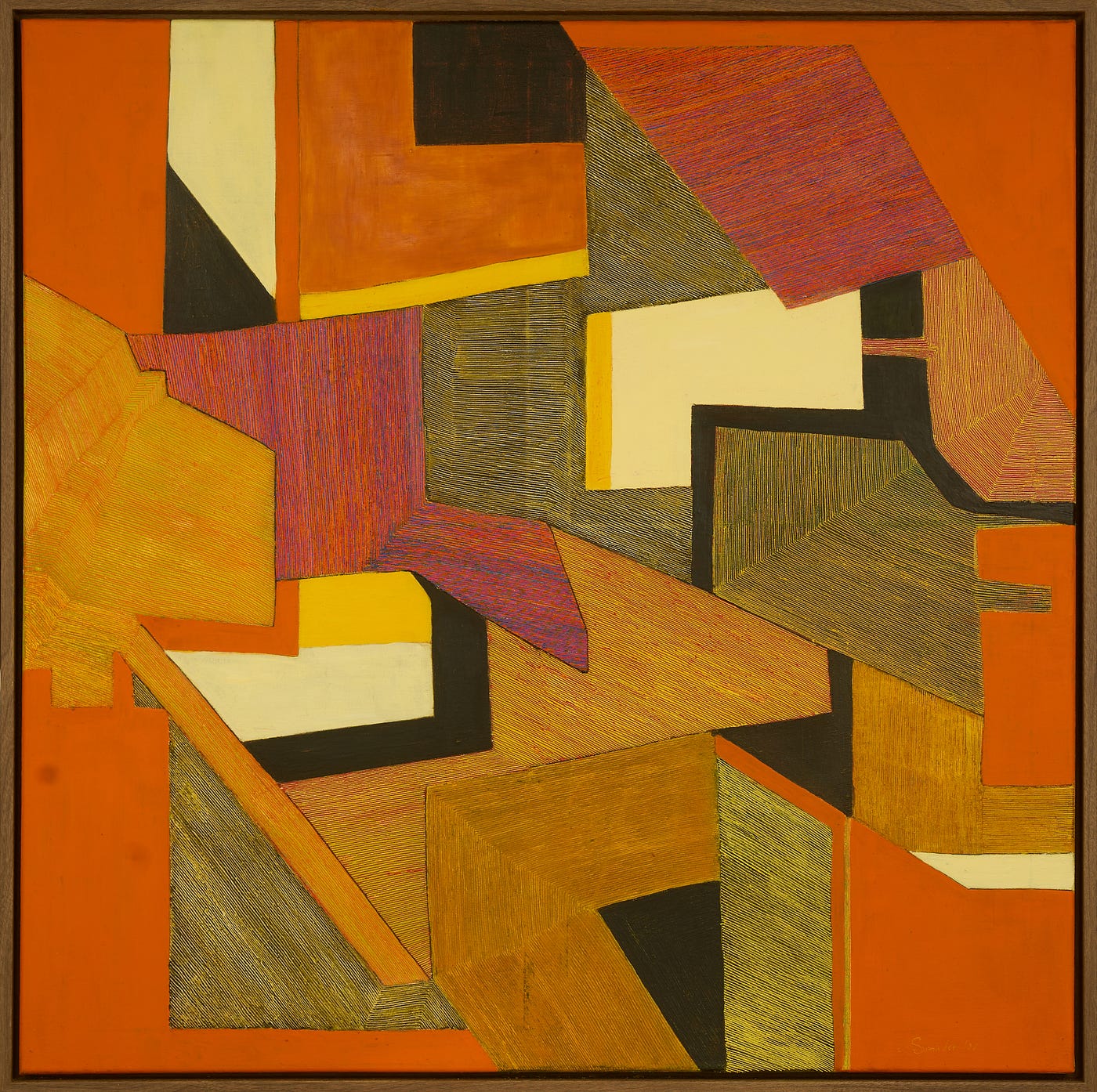
Stairs Missing (2026) holds these tensions in one square canvas. Ochre, maroon, black and cream planes meet at sharp angles. Rectangular spaces recede inside one another, while a gold diagonal suggests a ramp without confirming where it begins or ends. Depth is visible, but the route through it has been withheld. The title changes the painting: a staircase is normally understood through use before we consciously study it. Maurice Merleau-Ponty’s phenomenology describes perception through the body’s sense of I can. Virk turns that possibility into I cannot. The viewer anticipates climbing, crossing and entering, then meets an absence. This is why the work feels bodily even though no person appears.
For some Chandigarh residents, the city’s celebrated modernist order also carries a sense of loss. Le Corbusier’s plan divided neighbourhoods into numbered sectors, creating an efficient system of movement but often making the city less inviting to explore slowly on foot. Islamabad adopted a similar approach in its 1960 master plan by Constantinos A. Doxiadis, where separated sectors and wide roads gave priority to cars. Yet the grid itself is not necessarily the problem. Manhattan’s 1811 plan was equally rigid and commercially driven, but its smaller, denser blocks still encourage walking, chance encounters and street life. What matters is the purpose and scale of the grid. Manhattan developed around commerce and pedestrian activity, while Chandigarh and Islamabad expressed the order, speed and monumental ambitions of newly formed nation-states. Unlike the historic streets of London and Rome or any other organically grown city, where different periods remain layered together, these planned capitals often leave fewer opportunities to wander or pause. One can view Virk’s quiet, emptied façades which capture this tension between architectural order and the human life that struggles to inhabit it.
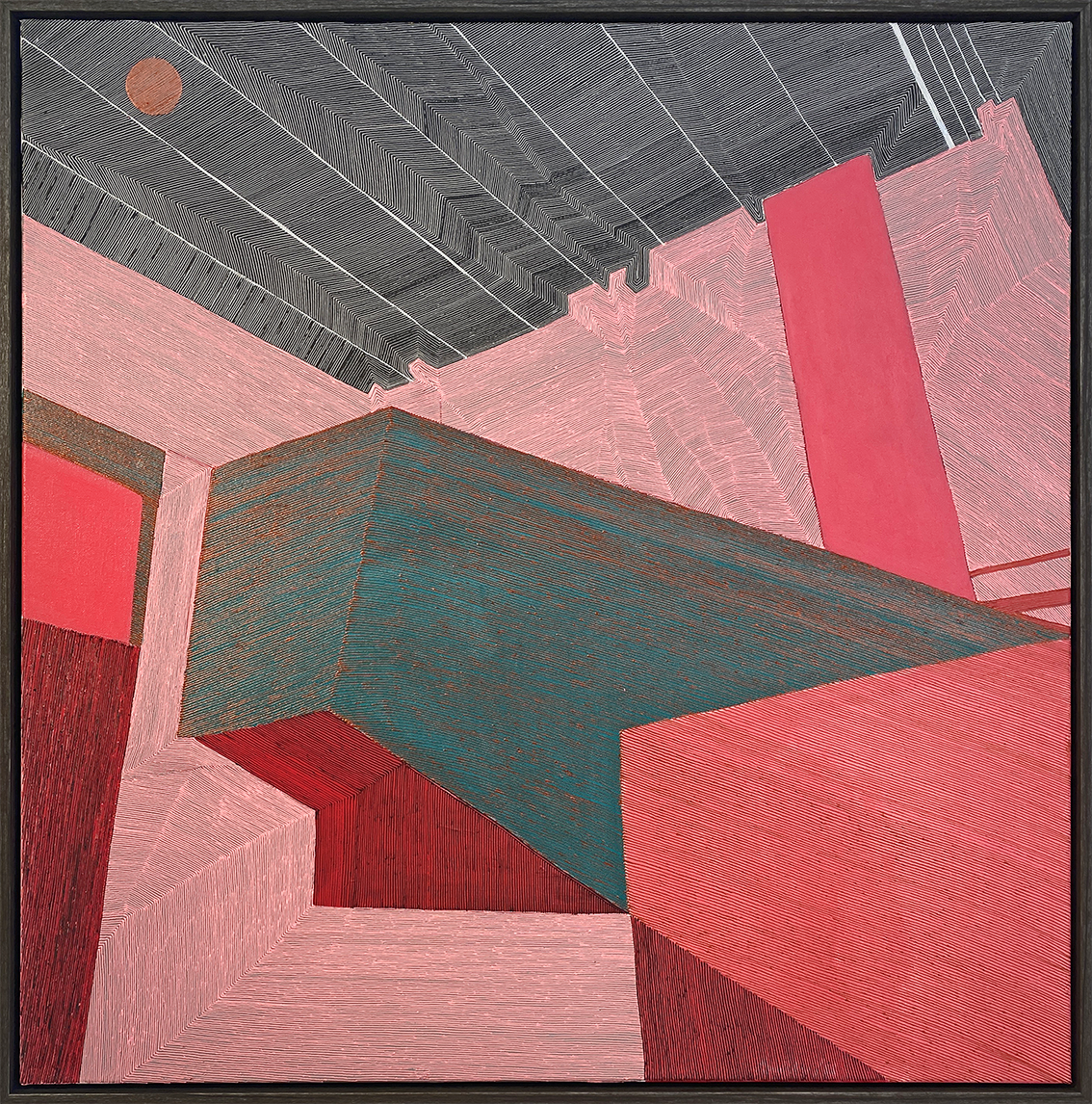
Signal Box (2025) is the only painting in this group based on a UK building. Its luminous blue and yellow reframe the Grade II-listed Birmingham New Street Signal Box, designed in 1964 by John Bicknell and Paul Hamilton with British Rail regional architect R. L. Moorcroft. Its sharply profiled precast concrete belongs to a post-war modernism shaped by Le Corbusier’s wider influence, not by a documented collaboration. For Virk, the connection is visual and lived. Birmingham’s concrete language speaks back to Chandigarh, while the contrasting colour recalls India. The colour prevents the building from settling into grey nostalgia and holds the tension of calling two places home.
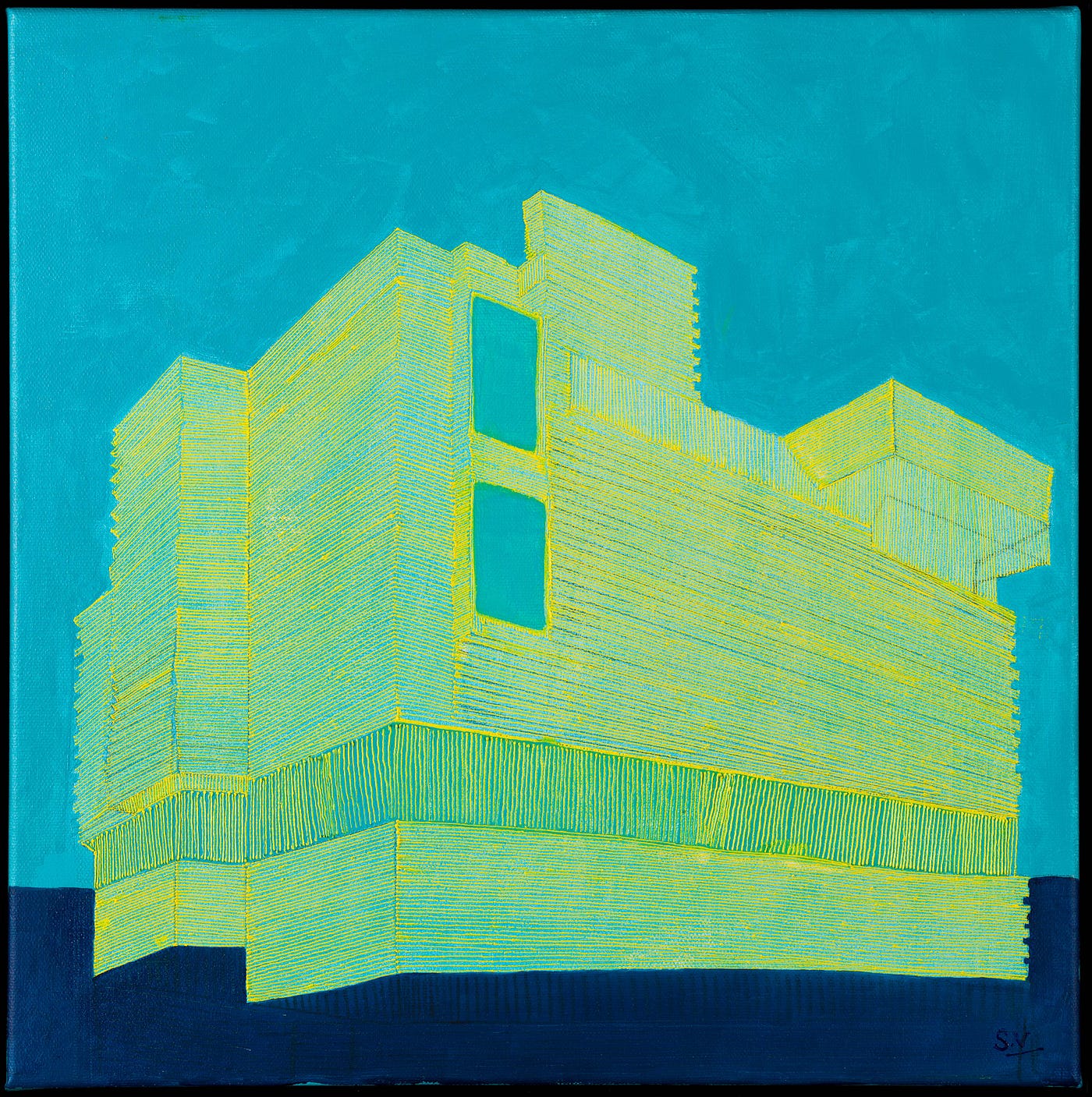
Seen together, Virk’s paintings refuse a simple division between India as origin and Britain as destination. Singporewala makes a similar refusal through ritual forms already carried across countries and generations. Homi Bhabha’s idea of a third space is useful because it locates cultural meaning in translation rather than in a protected original. The exhibition makes this material: a ses is remade in printed plastic, a henna-like line enters a modernist grid, and model figures become a ruined arch. Inherited forms are neither abandoned nor left untouched.
The exhibition is strongest when these ideas remain inside particular objects: a paper edge, plastic vessel, blocked stair or ridge of oil paint. Their structures belong because they have been worked on, not because they arrived unchanged.